St. Michael the Archangel – Prayer, Patron Saint, Schools
St. Michael the Archangel stands as one of the most venerated figures in Christian tradition, celebrated alongside Gabriel and Raphael on September 29. Revered as the prince of the heavenly host, he has long been invoked as a protector against evil, a warrior who led celestial forces against Lucifer and fallen angels. His name, derived from the Hebrew question “Who is like God?”, encapsulates a defiance that has resonated through millennia of religious devotion. From ancient scriptural accounts to modern Catholic schools bearing his name, St. Michael remains a powerful symbol of divine protection and spiritual warfare.
The archangel appears throughout Scripture in moments of cosmic significance, from the Book of Daniel to the Revelation of John. His role as guardian of Israel and champion against Satan established him as a central figure in both Catholic and Jewish tradition. Today, countless parishes, schools, and institutions carry his name, while believers continue to recite the Prayer to St. Michael composed by Pope Leo XIII in 1898. This article explores the biblical foundations, devotional practices, and cultural legacy of the archangel who stands as heaven’s defender.
What is the St. Michael the Archangel Prayer?
The Prayer to St. Michael stands as one of the most recognizable devotional texts in Catholic tradition. Pope Leo XIII composed this prayer in 1898 following a disturbing vision he experienced during Mass, in which he witnessed demonic forces gathering over Rome. The prayer invokes St. Michael to cast Satan into the abyss and defend the Church against spiritual enemies. Its rhythmic repetition of “Holy Michael, Archangel, defend us in battle” became a staple concluding prayer at Mass for decades.
Origins of the Devotion
Pope Leo XIII mandated the prayer’s inclusion at Mass in 1886 and later refined its text following his supernatural vision. The experience reportedly showed him the spiritual battle raging over the city, prompting him to create a prayer specifically invoking St. Michael’s protective power. Church documents from the period describe the Pope as visibly shaken after the vision, leading him to take decisive action. In 1994, Pope St. John Paul II encouraged the faithful to continue reciting the prayer daily, though the official requirement to pray it after Mass was later dropped.
- Composed in 1898 by Pope Leo XIII after a documented vision during Mass
- Originally mandated as the concluding prayer at every Mass
- Invokes Michael to cast Satan into the abyss and protect the Church
- Pope St. John Paul II personally encouraged daily recitation in 1994
- No longer required after Mass but remains popular among the faithful
- The name “Michael” means “Who is like God?” in Hebrew
The Chaplet of St. Michael
Beyond the familiar short prayer, the Chaplet of St. Michael offers a more extensive devotion honoring the archangel and the nine choirs of angels. This devotional practice involves reciting specific prayers while meditating on each choir of angels—angels, archangels, principalities, powers, virtues, dominations, throne, cherubim, and seraphim. The chaplet serves as a means of seeking St. Michael’s intercession for protection and spiritual strength. According to EWTN, this devotion has grown in popularity among those seeking the archangel’s powerful protection.
“Saint Michael the Archangel, defend us in battle; be our protection against the wickedness and snares of the devil. May God rebuke him, we humbly pray, and do thou, O prince of the heavenly host, by the power of God, cast into hell Satan and all the other evil spirits who prowl about the world seeking the ruin of souls.”
| Aspect | Details |
|---|---|
| Feast Day | September 29 (Michaelmas) |
| Patron Of | Soldiers, police, firefighters, dangerous professions |
| Bible Mentions | Book of Daniel, Book of Revelation, Epistle of Jude |
| Prayer Origin | Composed by Pope Leo XIII in 1898 |
| Name Meaning | “Who is like God?” in Hebrew |
| Scriptural Role | Guardian of Israel, leader of heavenly host |
| Traditional Iconography | Warrior in armor with sword and scales |
| Other Names | Michaelmas, Michael the Chief Prince |
What is St. Michael the Archangel the Patron Saint Of?
St. Michael holds numerous patronages that reflect his role as a celestial warrior and protector. The archangel serves as patron of soldiers, police officers, firefighters, and others in dangerous professions. His intercession is traditionally sought for protection during spiritual warfare, and he plays a central role in exorcism rituals where priests invoke his authority against demonic forces. The Church has long held that those facing mortal danger can turn to St. Michael for swift protection.
Traditional Patronages
Beyond military and emergency services, St. Michael’s patronage extends to the nation of Israel, which he guards as its heavenly defender according to the Book of Daniel. Many Catholic parishes and organizations focused on spiritual warfare consider him their special patron. At the moment of death, the faithful have traditionally invoked his name to ensure safe passage of the soul to eternal life. These patronages developed organically over centuries of Catholic devotion, rooted firmly in scriptural accounts of his interventions on behalf of God’s people.
St. Michael joins Gabriel (messenger of revelation) and Raphael (healer) as the three archangels named in Scripture. Together, they celebrate their feast day on September 29, a day formerly observed as a Holy Day of Obligation in the Catholic calendar. While the obligation was removed in the 18th century, the feast remains widely observed by the faithful. Those interested in guardian angels and their roles may find additional insights into angelic protection in Catholic tradition.
The patronages of St. Michael have influenced countless institutions worldwide, from police departments placing his image in stations to military units adopting him as their patron. His warrior imagery resonates particularly strongly with those who face physical danger in service to others, making him one of the most practically invoked saints in Catholic tradition. Schools named in his honor often emphasize discipline, protection, and service to community.
What is St. Michael the Archangel High School?
Numerous Catholic educational institutions bear the name St. Michael the Archangel, reflecting the saint’s enduring presence in American Catholic education. These schools typically combine academic excellence with faith formation, espousing values aligned with the archangel’s traditional symbolism of courage, protection, and divine service. Student bodies at these institutions often participate in service projects, retreats, and spiritual activities that reinforce the saint’s legacy.
Campus Life and Athletics
Like many Catholic high schools, St. Michael the Archangel institutions often feature robust athletic programs that include football, wrestling, and other competitive sports. These programs typically carry the archangel’s imagery in team identities, mascots, and spirit symbols. Athletic events often serve as community-building occasions where students, families, and parish members gather to support their teams. The intersection of faith and athletics reflects broader Catholic educational philosophy that values holistic development.
Schools bearing the archangel’s name frequently incorporate his imagery throughout their campuses through statues, murals, and chapel spaces. Students may participate in the Prayer to St. Michael before games or school-wide events, maintaining the devotional connection to their patron saint. According to information from St. Michael the Archangel Catholic School, these institutions maintain active athletics programs and community engagement initiatives.
Academic Programs and Identity
Catholic high schools named after St. Michael typically offer college preparatory curricula alongside religious education requirements. Students take courses in theology while pursuing standard academic tracks, often including Advanced Placement options. The integration of faith into daily learning reflects the broader Catholic educational mission to form students who embody Christian values in all areas of life. These institutions prepare graduates for higher education while grounding them in the spiritual heritage associated with their patron saint.
What is the St. Michael the Archangel Statue?
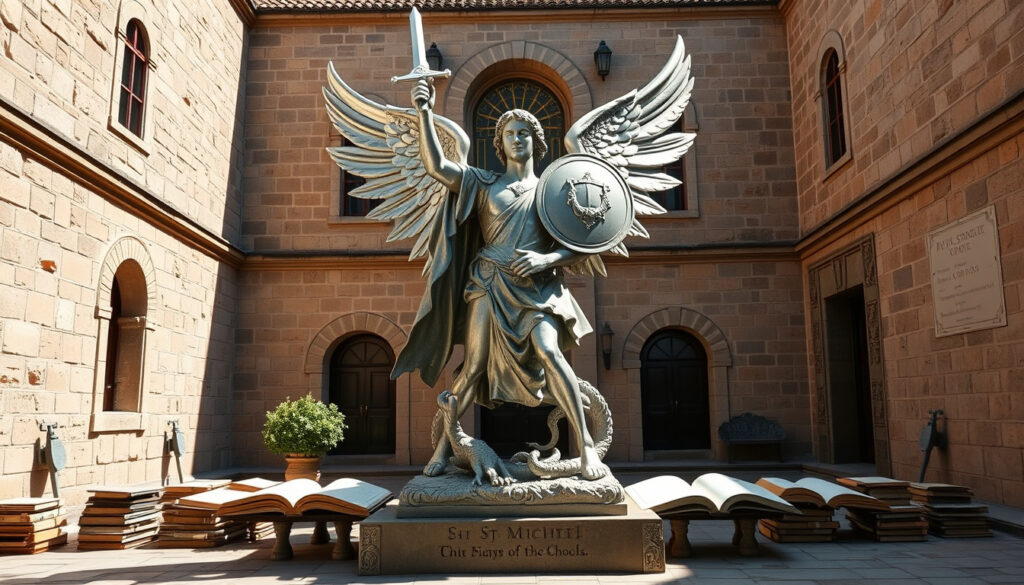
Statues depicting St. Michael the Archangel rank among the most recognizable religious sculptures in Western art and architecture. Traditional depictions show him as a warrior clad in armor, holding a sword pointed downward while standing atop a defeated Satan, often represented as a dragon or serpent. This imagery draws directly from the account in Revelation where Michael leads heavenly forces against the great dragon. Cathedral entrances, public squares, and churches frequently feature such statues as guardians of sacred space.
Artistic Traditions and Variations
Artistic representations of St. Michael have evolved over centuries, ranging from Byzantine mosaics to Renaissance paintings to modern bronze sculptures. Some depictions show him holding a balance scale, symbolizing divine justice, while others feature him with a banner or cross-topped spear. The common thread across all artistic traditions remains the archangel’s triumph over evil forces. Public monuments often place these statues prominently, suggesting their role as spiritual guardians for entire communities.
The St. Michael Tattoo
The warrior image of St. Michael has inspired tattoo artwork among Catholic faithful and others drawn to his symbolism. Many choose to permanently ink the archangel’s image—often in the traditional warrior pose defeating a dragon—as a personal declaration of faith or commitment to spiritual protection. These tattoos frequently incorporate scriptural quotations or the saint’s name in various languages. The practice reflects how traditional religious imagery continues to find expression in contemporary culture, particularly among those who identify strongly with the archangel’s protective role.
Tattoo artists specializing in religious imagery often report high demand for St. Michael designs, particularly among members of the military and emergency services who view the saint as their patron. The imagery resonates with themes of courage, overcoming adversity, and spiritual warfare that appeal to those facing difficult circumstances. Parish priests generally support such expressions of devotion when they reflect genuine faith rather than merely aesthetic choices.
Timeline of Key Events
The historical trajectory of St. Michael veneration spans from ancient scriptural appearances to modern devotional practices. Understanding this chronology helps place the archangel’s enduring significance within broader religious history. The timeline below traces major developments in both biblical references and institutional devotion that shaped how the faithful understand and invoke St. Michael today.
- Old Testament Era: St. Michael appears in the Book of Daniel as the guardian prince who stands for the children of Israel, described as a great prince who protects God’s people.
- First Century: The Epistle of Jude references Michael disputing with the devil over Moses’ body, while the Book of Revelation describes his cosmic battle casting Satan from heaven.
- Early Church Period: Devotion to St. Michael becomes universal throughout Christendom, with churches dedicated to him appearing across the Mediterranean world.
- Eleventh Century: The cult of Raphael develops, later joining Michael and Gabriel in the unified feast of the three archangels celebrated on September 29.
- 1886: Pope Leo XIII mandates the Prayer to St. Michael at the conclusion of every Mass.
- 1898: Following his vision of demonic forces, Pope Leo XIII finalizes the familiar text of the Prayer to St. Michael.
- 1994: Pope St. John Paul II personally encourages the faithful to pray the Prayer to St. Michael daily.
- Present Day: Devotion remains strong, with schools, churches, and institutions worldwide continuing to honor the archangel.
What the Record Shows: What We Know and What Remains Unclear
As with many figures from ancient religious tradition, the historical and scriptural record regarding St. Michael contains both well-established facts and areas of uncertainty. The Church affirms certain elements based on biblical text and traditional teaching, while other aspects remain open to theological interpretation or lack direct documentation.
| Established Information | Unclear or Interpretive Points |
|---|---|
| Biblical appearances in Daniel, Jude, and Revelation | Exact circumstances of Daniel’s visions featuring Michael |
| Role as guardian and protector of God’s people | Specific nature of Michael’s battle with Satan in heaven |
| Veneration by early Church and throughout history | Details of Pope Leo XIII’s exact vision during Mass |
| Composition of the Prayer to St. Michael by Pope Leo XIII in 1898 | Whether certain cultural traditions (specific tattoo meanings, school mascots) have formal Church approval |
| Patronage of soldiers, police, and dangerous professions | Extent of Jewish tradition’s understanding of Michael versus Catholic interpretation |
| Feast day celebrated on September 29 | Details of Islam’s recognition of Michael (Mikail) as an archangel of mercy |
The Archangel in Context: Scripture, Tradition, and Faith
St. Michael occupies a unique position among scriptural figures, appearing in contexts that bridge both the Jewish and Christian traditions. In the Book of Daniel, he is explicitly identified as the great prince who protects the children of Israel, suggesting a national guardianship role. The text describes him as standing ready to defend God’s people in a time of cosmic upheaval, establishing the template for later devotional understanding of his protective function. Catholic tradition has consistently interpreted these passages as establishing Michael’s ongoing role as spiritual guardian.
Within the New Testament, Michael’s appearance in Revelation presents him in his most dramatically warrior-like role, leading the angels in battle against Satan. This apocalyptic vision has shaped artistic depictions of the archangel for two millennia, inspiring countless paintings, sculptures, and devotional images. The Epistle of Jude’s brief reference to Michael disputing with the devil adds another dimension, suggesting he possesses authority in disputes between divine and demonic powers. Those exploring St. Gabriel’s role as the messenger angel may appreciate how different archangels serve distinct ministries within Catholic tradition. These scriptural foundations provided the basis for Catholic development of exorcism practices where priests invoke his name against evil spirits.
Sources and Scripture
“But Michael, the archangel, when he disputed with the devil and argued about the body of Moses, dared not bring a reviling accusation against him, but said, ‘The Lord rebuke you.'” — Jude 1:9
“And there was war in heaven. Michael and his angels fought with the dragon. And the dragon and his angels fought back, but they did not prevail, and there was no longer any place for them in heaven.” — Revelation 12:7-8
Scriptural references to St. Michael appear in three distinct books of the Bible, establishing the foundation for his later veneration. The Book of Daniel provides the most extensive treatment, presenting Michael as the protector of Israel during times of trial. The Book of Revelation offers the dramatic battle scene that became central to artistic representations. The brief mention in Jude establishes his role in spiritual authority. Together, these passages form the scriptural basis for everything that followed in Catholic devotion.
The Catholic Church’s official calendar identifies September 29 as the feast day for Sts. Michael, Gabriel, and Raphael, commonly known as Michaelmas. This celebration unites the three named archangels in a single feast, each recognized for distinct aspects of their ministry—Michael as warrior and protector, Gabriel as messenger, and Raphael as healer. The day holds historical significance as a former Holy Day of Obligation, though that requirement was relaxed in the 18th century. For more on the liturgical calendar, visit Catholic Culture.
Summary
St. Michael the Archangel remains one of the most influential figures in Catholic devotional life, combining scriptural prominence with centuries of religious practice. His appearances in Daniel, Jude, and Revelation established his identity as heaven’s champion against evil, a role that Catholic tradition has developed through the Prayer to St. Michael, the chaplet devotion, and the invocation of his patronage for those in dangerous professions. From medieval cathedrals to modern high schools, his name continues to inspire institutions dedicated to protection, courage, and service. The faithful continue to honor him through daily prayer, feast day celebrations, and artistic representations that carry his warrior imagery into contemporary contexts. Whether invoked against demonic forces, invoked for protection in battle, or honored through institutional names, St. Michael the Archangel endures as a powerful symbol of divine protection in the Catholic imagination. For related content on cultural phenomena affecting religious communities, see What Is 6 7 – TikTok Meme Disrupting Schools and Churches.
Frequently Asked Questions
What does the name “Michael” mean?
The name Michael derives from the Hebrew question “Mi cha el?”, which translates to “Who is like God?” This name encapsulates the defiance and faithfulness that characterize the archangel’s scriptural role.
Why do police officers and soldiers consider St. Michael their patron?
St. Michael’s traditional role as a heavenly warrior who battles evil made him a natural patron for those who face physical danger in service to others. Catholic soldiers, police officers, and firefighters have long invoked his protection.
Is the Prayer to St. Michael still said at Mass?
While Pope Leo XIII mandated the prayer after Mass in 1886 and it remained standard practice for many decades, it is no longer officially required. Pope St. John Paul II encouraged daily recitation by the faithful, and many parishes continue the practice voluntarily.
What is the connection between St. Michael and exorcisms?
Catholic exorcism rituals invoke St. Michael’s authority and power against demonic forces. Priests conducting exorcisms call upon the archangel’s role as heaven’s champion to cast out evil spirits, a practice rooted in his scriptural depiction as Satan’s conqueror.
What are the nine choirs of angels honored in the Chaplet of St. Michael?
The nine choirs include angels, archangels, principalities, powers, virtues, dominations, thrones, cherubim, and seraphim. The chaplet devotion incorporates prayers to St. Michael while meditating on each choir in sequence.
When is St. Michael’s feast day celebrated?
The feast day for St. Michael the Archangel, along with Gabriel and Raphael, is September 29. This celebration, known as Michaelmas, was formerly a Holy Day of Obligation in the Catholic calendar.
More related posts
 Green Noise for Sleep – Softer Nature Sounds for Rest
 Flower Names for Girls: Unique, Vintage & International
 Cast of Kinda Pregnant – Complete Cast List and Roles
 Federal Mileage Rate 2024 – Official IRS Rates and Rules
 Amazon Customer Service Phone Number: UK, Ireland, US
 Milwaukee Bucks vs Miami Heat Match Player Stats: July 2026
 Capital One Auto Loan: Rates, Login, Phone & Reviews
 Cash App Class Action Settlement 2025: Claim Your Payout
