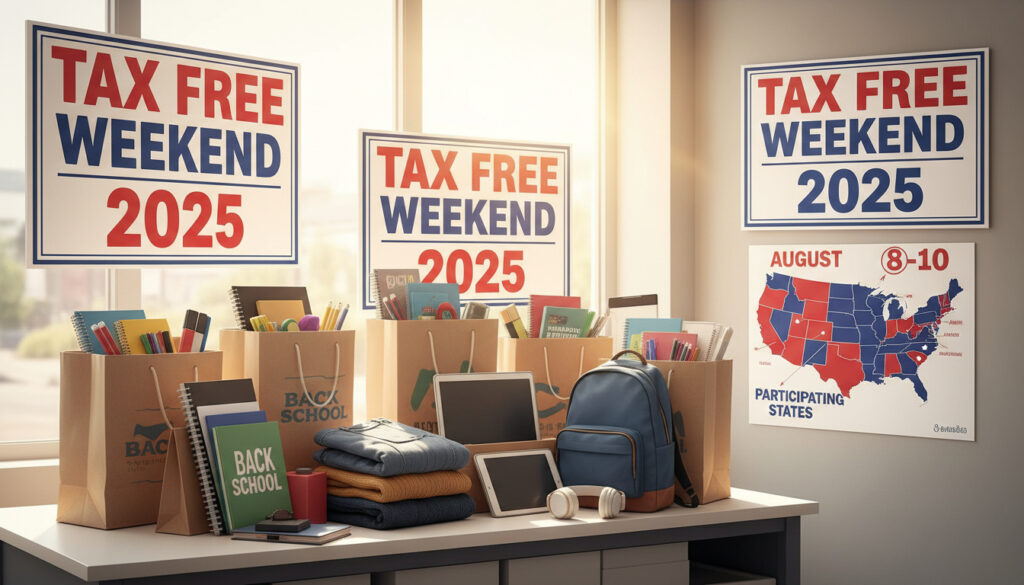
Tax Free Weekend 2025 – Dates, States and Rules
Tax free weekend 2025 offers shoppers temporary relief from state sales tax on back-to-school essentials across eighteen states plus Washington, D.C. These annual events, held primarily in late July and August, suspend sales tax collection on qualifying merchandise such as clothing, footwear, and school supplies, providing immediate savings tied to specific price thresholds. While the concept appears straightforward, execution varies significantly by state, with differing dates, eligible items, and participation rules creating a patchwork of regulations.
The 2025 calendar marks notable shifts, including Louisiana’s discontinuation of its holiday after June 30 and Texas’s legislative change shifting its event to 2026. Fidelity’s tax research confirms that most holidays run from 12:01 a.m. on the first day until midnight on the final day, though precise schedules diverge widely. Understanding these distinctions proves essential for families budgeting for seasonal expenses and for retailers managing compliance.
Five states—Alaska, Delaware, Montana, New Hampshire, and Oregon—operate without statewide sales tax year-round, rendering the question of participation moot for their residents. For the remaining jurisdictions, eligibility windows represent narrow opportunities to reduce transaction costs by 4% to 9%, depending on local rates.
When Is Tax Free Weekend 2025 and Which States Participate?
Active programs for 2025
Peak holiday window
Clothing, supplies, computers
Typical state tax relief
Sixteen states have confirmed specific dates, with activity concentrated in late summer. Avalara’s 2025 analysis indicates that Alabama opens the season earliest, while Florida offers the longest continuous window.
- Early Opening: Alabama and New Mexico begin July 18–20 and July 25–27 respectively.
- Extended Windows: Florida maintains exemptions throughout August; Ohio spans August 1–14.
- Highest Threshold: Massachusetts exempts tangible personal property up to $2,500.
- Limited Scope: Mississippi restricts its August 29–31 holiday to hunting supplies.
- 2026 Transition: Texas postpones its holiday to the first Friday–Sunday of August 2026.
- Budget Dependency: Ohio requires confirmed surplus authorization before finalizing dates.
- Program Elimination: Louisiana ended its sales tax holiday after June 30, 2025.
| State | 2025 Dates | Clothing/Footwear Limit | Computers Allowed? |
|---|---|---|---|
| Alabama | July 18–20 | $100 | Yes ($750) |
| Arkansas | Aug. 2–3 | $100 | Yes (electronic devices) |
| Connecticut | Aug. 17–23 | $100 | No |
| Florida | Aug. 1–31 | $100 | Yes ($1,500) |
| Iowa | Aug. 1–2 | $100 | No |
| Maryland | Aug. 10–16 | $100 | No |
| Massachusetts | Aug. 9–10 | N/A ($2,500 tangible property) | Yes |
| Mississippi | Aug. 29–31 | N/A (hunting supplies) | No |
| Missouri | Aug. 1–3 | $100 | Yes ($3,500) |
| New Mexico | July 25–27 | $100 | Yes ($1,000) |
| Ohio | Aug. 1–14 | N/A ($500 tangible property) | Yes (if ≤$500) |
| Oklahoma | Aug. 1–3 | $100 | No |
| South Carolina | Aug. 1–3 | No limit | Yes (no limit specified) |
| Tennessee | July 25–27 | No limit specified | Yes |
| Texas | TBA (2026 start) | Typically $100 | Typically yes |
| West Virginia | Fri before 1st Sun in Aug. to following Mon | Varies | Varies |
What Can You Buy Tax-Free During the 2025 Sales Tax Holiday?
Eligible Categories and Spending Caps
Most participating jurisdictions limit exemptions to tangible personal property intended for personal use. Consolidated Credit’s state-by-state analysis confirms that clothing and footwear face universal price caps, typically $100 per item. This threshold operates as a cliff: a $120 pair of shoes incurs full sales tax on the entire amount, not merely the $20 overage.
Computer exemptions vary significantly by market value. Alabama allows systems up to $750, while Missouri permits purchases reaching $3,500. New Mexico splits equipment categories, capping computers at $1,000 and related equipment at $500. School supplies typically face lower thresholds, ranging from $30 in New Mexico to $50 in Florida and Missouri.
Common Exclusions and Limitations
Accessories such as jewelry, handbags, and belts generally fall outside exemption boundaries despite clothing eligibility. Electronics beyond computers—smartphones, televisions, and video games—rarely qualify. The Sales Tax Institute notes that business purchases, rentals, vehicles, prepared food, and tobacco products face universal exclusion.
Exceeding per-item price limits voids the exemption entirely. A $101 dress purchased in a $100-limit state triggers sales tax on the full $101, not merely the excess dollar.
What Is Tax Free Weekend and How Does It Work?
The Mechanics of Tax Exemption
Sales tax holidays temporarily eliminate state-level collection on specified merchandise, typically beginning at 12:01 a.m. on the first day and concluding at midnight on the final day. The Federation of Tax Administrators confirms that retailer participation is mandatory in most jurisdictions; stores cannot opt out or charge tax on qualifying items during the designated period.
The exemption applies primarily to state sales tax. Local taxes may still apply unless specific legislation suspends them. Connecticut, for example, eliminates only the state portion, preserving municipal levies.
Online Orders and Delivery Timing
TaxCloud’s compliance data indicates that digital transactions qualify provided payment occurs during the holiday window. For delivery spanning multiple days, the payment date determines eligibility rather than the shipping date. Consumers ordering online must verify that retailers process charges within the exact timeframe, as authorization holds placed before the holiday may disqualify the purchase.
How to Maximize Savings on Tax Free Weekend 2025
Strategic Shopping Approaches
Planning purchases around confirmed state dates prevents forfeiting savings. Consumers should verify final prices against thresholds before checkout, as sale prices combined with coupons might push items below caps, while add-ons like embroidery could push them over. TaxJar’s 2025 guidance suggests shopping early in multi-day windows to ensure inventory availability for high-demand items like specific computer models.
Verification and Documentation
Ohio’s Department of Taxation emphasizes that its August 1–14 dates require confirmed budget surplus authorization, creating potential for last-minute cancellation. Reviewing official state revenue portals before finalizing purchases ensures compliance with current exemption rules and confirms no legislative amendments have altered schedules.
State laws require most retailers to participate. Stores cannot legally charge sales tax on qualifying items during the exemption period, regardless of register programming errors or administrative convenience.
Several states exempt only state-level sales tax, meaning city or county taxes may still apply. Calculate true final costs by verifying municipal regulations in your specific jurisdiction.
How Have Sales Tax Holidays Developed Over Time?
-
Iowa enacts its first sales tax holiday, establishing the back-to-school model that other states would later adopt.
-
Oklahoma introduces its exemption for clothing and footwear, expanding the geographic spread of tax-free periods.
-
Maryland launches back-to-school specific holidays, refining the concept beyond general tax relief toward targeted educational support.
-
Alabama diversifies eligible categories by adding severe weather preparedness holidays, broadening the policy’s application beyond education.
-
Ohio implements budget-contingent authorization, creating a precedent for fiscal responsibility tied to temporary tax relief.
-
Louisiana discontinues its sales tax holiday program entirely, marking a contraction in participating jurisdictions.
-
Texas shifts permanent holiday dates to the first Friday–Sunday of August, standardizing its schedule for future years.
What Is Confirmed for 2025 and What Remains Uncertain?
| Established Information | Pending or Unclear |
|---|---|
| Alabama: July 18–20 | Texas: 2025 dates TBA pending 2026 legislative transition |
| Florida: August 1–31 | Ohio: Contingent on final budget surplus confirmation |
| Louisiana: Program definitively ended June 30, 2025 | West Virginia: Specific price limits undetermined |
| Alabama CPI adjustments commence 2026 | Potential additional states beyond the 16 confirmed |
| Five states maintain zero sales tax year-round | Exact local tax treatment in hybrid jurisdictions |
Why Do States Offer Tax-Free Shopping Periods?
Does Sterling Silver Tarnish – Causes, Prevention and Cleaning Guide. Sales tax holidays emerged during the 1990s as competitive responses to states lacking income taxes, aiming to stimulate retail activity during back-to-school seasons. The policy mechanism serves dual purposes: providing tangible financial relief to families facing seasonal education expenses while generating concentrated revenue spikes for local businesses.
Post-2010 expansions saw states adopt increasingly targeted frameworks. Economic impact studies remain mixed, with some analyses suggesting the holidays merely shift the timing of purchases rather than increasing overall economic activity. Nevertheless, consumer awareness continues growing annually, driving political support for retention and expansion of these temporary exemptions.
Authority and Source Attribution
Eighteen states plus Washington, D.C., offer sales tax holidays in 2025, primarily focused on back-to-school items with dates concentrated in July and August.
— Federation of Tax Administrators, 2025 Sales Tax Holidays
Alabama will adjust its price caps every five years beginning in 2026 based on the Consumer Price Index, marking the first automatic escalation mechanism among participating states.
— Avalara Tax Research, 2025 Sales Tax Holidays Analysis
Key Takeaways for 2025 Tax-Free Shopping
Families across eighteen states can anticipate sales tax savings during late summer windows, provided they verify specific dates, respect per-item price ceilings, and confirm retailer participation. With Texas postponing its event and Louisiana ending its program entirely, cross-border shopping requires careful jurisdictional verification. Green Noise for Sleep – Softer Nature Sounds for Rest. Reviewing official state revenue portals before finalizing purchases remains the most reliable method for ensuring compliance with current exemption rules.
Frequently Asked Questions
Does tax free weekend apply to online purchases?
Yes, if payment is processed during the holiday period. Delivery timing matters less than the transaction date, though orders must ship to addresses within the participating state.
Can retailers charge sales tax during the holiday anyway?
No. In most participating states, retailer participation is mandatory. Charging tax on qualifying items violates state law, regardless of register programming limitations.
What happens if I buy an item that exceeds the price limit?
The entire item becomes taxable, not just the amount over the limit. A $101 purchase in a $100-limit state incurs sales tax on the full $101.
Is tax free weekend exclusively for back-to-school shopping?
Primarily, though some states include other categories. Mississippi focuses on hunting supplies in late August, while Florida extends exemptions to fishing gear in September.
Do local sales taxes still apply during the holiday?
Sometimes. States like Connecticut exempt only state tax, allowing local taxes to remain. Others suspend both. Verify municipal rules for your specific location.
Can businesses purchase tax-free items?
No. All exemptions require personal use. Business purchases, rentals, and items for resale remain fully taxable regardless of the holiday timing.
More related posts
 Harry Potter and the Sorcerer’s Stone Cast: Complete List
 Fish Oil for Dogs – Dosage, Benefits and Safety Guide
 Chick-fil-A Near Me: UK, Ireland Locations & Menu Guide
 RR vs RCB Match Scorecard 2026: Result, Records & Team Weaknesses
 Pasta e Fagioli Soup – Authentic Recipe, History and Nutrition
 Teaching Jobs Near Me: Demand, Salary, and How to Find in Ireland
 How to Get Rid of Roaches: Fast, Permanent Solutions
 6000 Yen to USD – Current Rate, Trends and Conversion Tips
