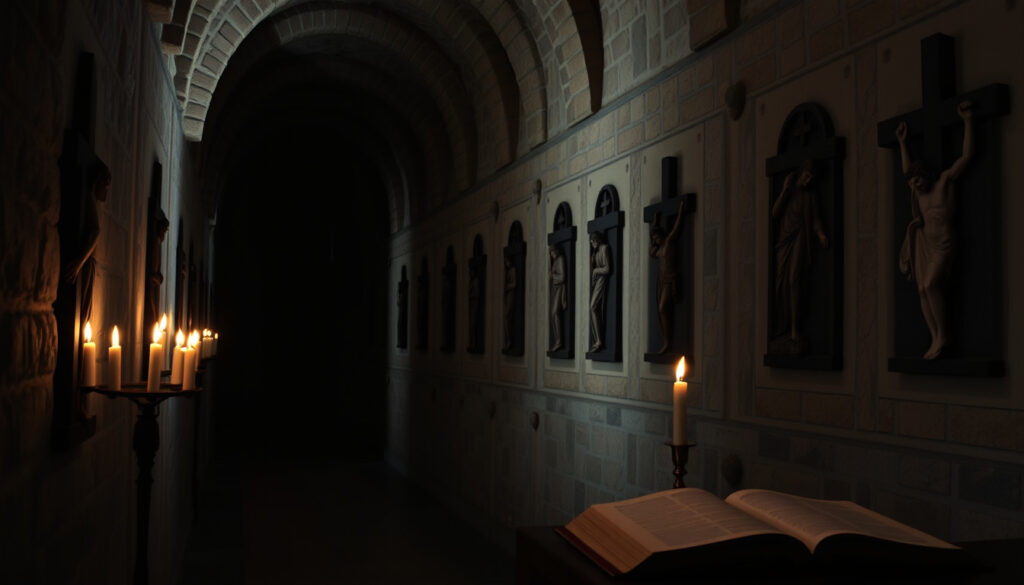
Stations of the Cross: 14 Stations, Prayers & Free PDF Guide
If you’ve ever walked through a church and noticed small crosses mounted along the walls, you’ve encountered the Stations of the Cross — a devotion that asks participants to mentally travel through Jesus’s final hours. This guide walks through all 14 traditional stations, the prayers attached to each stop, and where to download free PDF resources for home or church use. Pope Clement XII fixed the number of stations at exactly 14 in 1731, and the practice remains a centerpiece of Lenten observance in Catholic parishes worldwide.
Traditional Count: 14 · Primary Observance: Lent and Good Friday · Core Devotion: Catholic prayer commemorating Christ’s Passion · Standard Format: Processional or meditative walk · Key Elements: Prayers, reflections, indulgences
Quick snapshot
- 14 stations standardized by Pope Clement XII in 1731 (Museum of the Bible)
- Catholic, Anglican, and Lutheran parishes observe the devotion during Lent (Museum of the Bible)
- St. Leonard of Port Maurice erected nearly 600 sets of Stations across Italy (Franciscan Media)
- Whether all local parishes use identical wording for prayers (varies by diocese)
- Exact path specifics along Jerusalem’s Via Dolorosa (pilgrims dispute markers)
- Pre-5th-century origins remain historically ambiguous (early accounts sparse)
- 5th century: churches began replicating Jerusalem sites for pilgrims (Museum of the Bible)
- 1686: Pope Innocent XI granted Franciscans station erection rights (Wikipedia)
- 1991: Pope John Paul II introduced a Gospel-based version for Good Friday (USCCB)
- Free PDF booklets available from USCCB, cathedral parishes, and dioceses
- Modern adaptations increasingly emphasize Scriptural grounding over traditional imagery
- Televised Colosseum Stations on Good Friday draw millions of remote participants
| Label | Value |
|---|---|
| Number of Stations | 14 |
| Liturgical Season | Lent |
| Commemorates | Passion of Christ |
| Practice Origin | 5th century |
| Versions | Traditional, Scriptural, Modern |
What are the 14 Stations of the Cross in order?
The traditional Stations of the Cross trace a 14-step path through Jesus’s final hours, from condemnation to burial. Pope Clement XII standardized the number at 14 in 1731, though the practice traces back centuries earlier to pilgrims unable to reach Jerusalem’s Via Dolorosa. At each station, participants genuflect and recite a short response: “We adore You, O Christ, and we praise You. Because, by Your holy cross, You have redeemed the world.”
1st Station: Jesus is condemned to death
- Traditional: Pontius Pilate pronounces the sentence while the crowd calls for crucifixion (Mk 15:6-15).
- Scriptural version uses the same Gospel accounts as the basis for meditation.
2nd Station: Jesus takes up his Cross
- Jesus receives his cross and begins the march toward Golgotha (Jn 19:15-17).
- The weight of the cross represents the burden of humanity’s sins.
3rd Station: Jesus falls for the first time
- One of three falls in the traditional sequence; this station is not directly scriptural but reflects human experience.
- Only 9 of the 14 traditional stations are directly biblical; others come from tradition (Franciscan Media).
4th Station: Jesus meets his Mother
- Mary intercepts her son along the path; this moment of maternal grief is drawn from tradition rather than specific Gospel narrative.
5th Station: Simon of Cyrene carries the Cross
- A passerby is forced to help Jesus carry the cross (Mt 27:32).
6th Station: Veronica wipes Jesus’s face
- The woman who wiped Christ’s face is named Veronica in tradition; this event is not scriptural.
7th Station: Jesus falls the second time
- The second fall is another moment of human solidarity, emphasizing Christ’s physical suffering.
8th Station: Jesus meets the weeping women
- Jesus tells the women of Jerusalem not to weep for him but for themselves and their children.
9th Station: Jesus falls the third time
- The final fall underscores the exhaustion and pain leading to crucifixion.
10th Station: Jesus is stripped of his garments
- Soldiers divide his clothing among themselves (Jn 19:23-24).
11th Station: Jesus is nailed to the Cross
- The crucifixion scene draws from all four Gospels.
12th Station: Jesus dies on the Cross
- The central moment of the Passion narrative; Jesus breathes his last (Mk 15:37).
13th Station: Jesus is taken down from the Cross
- Joseph of Arimathea requests the body and it is lowered from the cross (Jn 19:38-40).
14th Station: Jesus is laid in the sepulcher
- The body is placed in the tomb, concluding the journey through Christ’s Passion.
Not all 14 traditional stations are rooted in Scripture. Five events — the three falls, Veronica’s gesture, and the encounters with Mary and the women — come from tradition rather than Gospel text. The Scriptural version approved by Pope John Paul II in 1991 includes only Gospel-based events, reducing the stations to align more closely with biblical accounts.
14 Stations of the Cross Prayers
The prayers accompanying each station guide participants through reflection and supplication. St. Alphonsus Liguori authored one of the most widely used prayer guides, found in many parish PDFs today. The devotion begins with an opening prayer such as “God of power and mercy, in love You sent Your Son,” and continues through each station with a brief meditation followed by the response “We adore You, O Christ, and we praise You.”
Prayers for each station
- Opening: “God of power and mercy, in love You sent Your Son…” (USCCB Scriptural version)
- At each station: “V. We adore You, O Christ, and we praise You. R. Because, by Your holy cross, You have redeemed the world.”
- Closing: After completing all 14 stations, participants recite five Our Fathers, five Hail Marys, five Glory Bes for the intentions of the Holy Father, and one for the souls in Purgatory.
Indulgences associated
- Catholic tradition grants indulgences to those who complete the Stations worthily, a practice recognized by the Church for centuries.
- Requirements typically include meditating on Christ’s Passion and receiving sacramental confession.
The structure of the devotion combines vocal prayer with meditative reflection. Unlike simply reading scripture, the physical movement from station to station creates a embodied experience that parishes have found effective for Lenten formation.
Stations of the Cross PDF Free Download
Free PDF resources make the Stations accessible for home prayer, classroom use, or parish bulletins. Several diocesan and cathedral sites publish downloadable guides ranging from simple text versions to illustrated booklets suitable for children.
Traditional PDF
- Holy Rosary Cathedral (St. Alphonsus Liguori prayers) — Full Way of the Cross text with traditional meditations
- St. Michael’s Cathedral PDF — Parish booklet format suitable for printing
Catholic version
- USCCB Scriptural Stations (Pope John Paul II version) — Official Catholic version based entirely on Gospel accounts, free to download
- USCCB overview page — Historical context and liturgical guidance
Modern adaptations
- CRS Rice Bowl Lenten Stations — Modern version with contemporary reflections and prayers
- Ossory Diocese and Dublin Diocese publish modern adaptations for contemporary congregations.
How to Pray the Stations of the Cross
The Stations of the Cross can be prayed individually at home, with a group in church, or led by a priest during Lenten services. The practice functions as a mini-pilgrimage, with participants moving physically from one station to the next in churches where the stations are installed on the walls.
Step-by-step process
- Begin with an opening prayer acknowledging Christ’s sacrifice and your intention to enter more deeply into his Passion.
- Move to the first station. Read the scripture passage and meditation appropriate to that stop.
- Genuflect toward the station cross and recite the response: “We adore You, O Christ, and we praise You. Because, by Your holy cross, You have redeemed the world.”
- Continue through all 14 stations in sequence, pausing briefly for personal reflection between each.
- Conclude with the prescribed prayers: Our Father, Hail Mary, Glory Be, and a closing prayer for the Pope’s intentions.
At church or home
- In church: Walk the station circuit if your parish has installed crosses and images. If no physical stations exist, remain seated and have someone read aloud or use a printed guide.
- At home: Print a PDF guide, create a makeshift station arrangement with 14 crosses, or simply read through the devotion quietly in your own space. The USCCB offers free printable guides suitable for home use.
During Lent
- Many parishes schedule Stations prayer services on Fridays during Lent, particularly on Good Friday.
- The devotion is most commonly associated with the 40 days of Lent, though it can be prayed year-round.
- Pope John Paul II led Stations from Rome’s Colosseum on Good Friday beginning in the 1980s, and the event is now televised internationally.
The physical movement involved in walking the Stations creates a sensory experience that reading alone cannot replicate. Even at home, participants who physically move from room to room or genuflect at each station report a deeper sense of pilgrimage and reflection.
Traditional vs Modern Stations of the Cross
Two main versions of the Stations exist in contemporary Catholic practice: the traditional 14-station form standardized in 1731, and the Scriptural version approved by Pope John Paul II in 1991. Understanding the differences helps participants choose the approach that best fits their spiritual needs.
Traditional 14
- Full 14 stations with traditional meditations written by St. Alphonsus Liguori.
- Includes five events not found in Scripture: the three falls, Veronica’s gesture, and encounters with Mary and the women.
- Available in most Catholic churches with station installations.
- Carries a plenary indulgence when prayed devoutly.
Modern versions
- Scriptural version: Pope John Paul II’s 1991 version uses only Gospel-based events.
- USCCB publishes this version with direct scriptural citations for each station.
- Some modern adaptations integrate contemporary social concerns, such as the CRS Rice Bowl version connecting Stations to Catholic Relief Services’ charitable work.
Scriptural stations
- Fewer stations (typically fewer than 14 in some implementations) but grounded entirely in Gospel accounts.
- Preferred by parishes seeking to emphasize biblical literacy.
- The twelfth station in the Scriptural version: Jesus speaks to his mother and disciple (Jn 19) rather than the death on the cross.
| Version | Biblical basis | Station count | Indulgence? |
|---|---|---|---|
| Traditional (St. Alphonsus) | 9 of 14 scriptural | 14 | Yes |
| Scriptural (John Paul II) | All Gospel-based | 14 | Yes |
| Modern adaptations | Varies | Varies | Check parish |
The comparison table shows how the traditional version balances scriptural events with devotional tradition, while the Scriptural version prioritizes biblical fidelity. The pattern suggests parishes can choose based on their liturgical priorities, whether emphasizing historical practice or direct Gospel engagement.
The traditional version’s non-scriptural stations — particularly the three falls and Veronica’s encounter — may seem historically questionable to those seeking strictly biblical fidelity. However, devotional tradition holds that these moments speak to universal human experiences of suffering, weakness, and the compassion that strangers can offer. The Scriptural version eliminates that ambiguity but sacrifices the traditional imagery that many Catholics find most emotionally resonant.
Related reading: St. Michael the Archangel prayer · Valentine’s Day history and traditions
museumofthebible.org, franciscanmedia.org, catholicreview.org, ssaparish.com, traditionalcatholicprayers.com, catholicnh.org, en.wikipedia.org
Frequently asked questions
Why are there 14 Stations?
Pope Clement XII standardized the number of stations at exactly 14 in 1731. Before that ruling, the number varied — some traditions included hundreds of stations, while others used as few as seven. The number 14 became universal after Clement XII’s decree extended the right to erect stations to all churches, not just Franciscan-run ones.
How do you pray the Stations of the Cross?
At each station, read or listen to the scripture passage and meditation, then genuflect and recite the response: “We adore You, O Christ, and we praise You. Because, by Your holy cross, You have redeemed the world.” After completing all 14 stations, pray five Our Fathers, Hail Marys, and Glory Bes for the Pope’s intentions. The devotion can be prayed alone, with a group, or led by a priest.
When are the Stations of the Cross prayed?
The Stations are most commonly prayed during Lent, particularly on Fridays and on Good Friday. Many parishes hold communal Stations services every Friday of Lent. Pope John Paul II led a public Stations service from Rome’s Colosseum on Good Friday beginning in the 1980s, an event now televised globally.
Are there indulgences for the Stations?
Yes, the Catholic Church grants a plenary indulgence to those who complete the Stations worthily — meaning they are in a state of grace, have confessed recent sins, and have received the Eucharist. A partial indulgence applies to those who participate without fulfilling all conditions. The indulgence applies to both traditional and Scriptural versions when prayed properly.
What is the difference between traditional and Scriptural Stations?
The traditional version includes 14 stations, but only 9 of them are directly grounded in Scripture. The five non-scriptural stations — including the three falls, Veronica wiping Jesus’s face, and his encounter with Mary — come from devotional tradition. The Scriptural version, approved by Pope John Paul II in 1991, uses only Gospel-based events, resulting in stations that directly cite biblical passages for each meditation.
Can you pray the Stations at home?
Yes, the Stations can be prayed at home without a church installation. Printable PDF guides are available from USCCB, cathedral parishes, and other Catholic resources. At home, participants can either create a physical station arrangement with 14 crosses or simply read through the devotion. The USCCB free PDF is particularly suitable for home printing and personal use.
Why did Pope Paul VI approve a Gospel-based version in 1975?
Pope Paul VI sought to emphasize the biblical foundation of the devotion, reducing emphasis on non-scriptural events that had accumulated in the traditional version. His approval of a Gospel-based version paved the way for Pope John Paul II’s more widely adopted 1991 revision, which further refined the balance between scriptural fidelity and devotional tradition.
Quotes
“The Stations of the Cross are a fourteen-step Catholic devotion that commemorates Jesus Christ’s last day on Earth as a man.”
— St. Alphonsus Liguori tradition, Holy Rosary Cathedral PDF
“Not all 14 Stations are based in Scripture, but they do touch our human experience.”
— Franciscan Media (Franciscan Media, Catholic traditions publisher)
“Lord Jesus, help us walk in your steps.”
— USCCB Scriptural Stations response prayer (United States Conference of Catholic Bishops, official Catholic teaching body)
The traditional version’s non-scriptural stations — particularly the three falls and Veronica’s encounter — may seem historically questionable to those seeking strictly biblical fidelity. However, devotional tradition holds that these moments speak to universal human experiences of suffering, weakness, and the compassion that strangers can offer. The Scriptural version eliminates that ambiguity but sacrifices the traditional imagery that many Catholics find most emotionally resonant.
For Catholics seeking a structured Lenten devotion, the choice between traditional and Scriptural versions comes down to preference: those who value the full 14-station imagery inherited from centuries of Catholic practice will find the Holy Rosary Cathedral PDF most complete, while those who prefer strictly biblical grounding will appreciate the USCCB version’s direct scriptural citations. Families with children may find the modern CRS Rice Bowl version most accessible. In all cases, the core invitation remains the same: to walk mentally and spiritually alongside Christ in his final hours, letting the journey reshape the prayer’s heart.
More related posts
 Can You Live Without a Pancreas? Survival and Life Expectancy
 Brazil National Football Team Players: 2026 World Cup Squad Guide
 Can Cats Eat Watermelon? Safety, Risks & Feeding Guide
 Free AI Logo Generator: 5 Best Tools Without Watermark
 Oscar De La Hoya: Net Worth, Face Injury & Boxing Legacy
 Time in Las Vegas: Current Local Time, Zone & DST Info
 Lorraine Bracco Movies and TV Shows: Full Filmography
