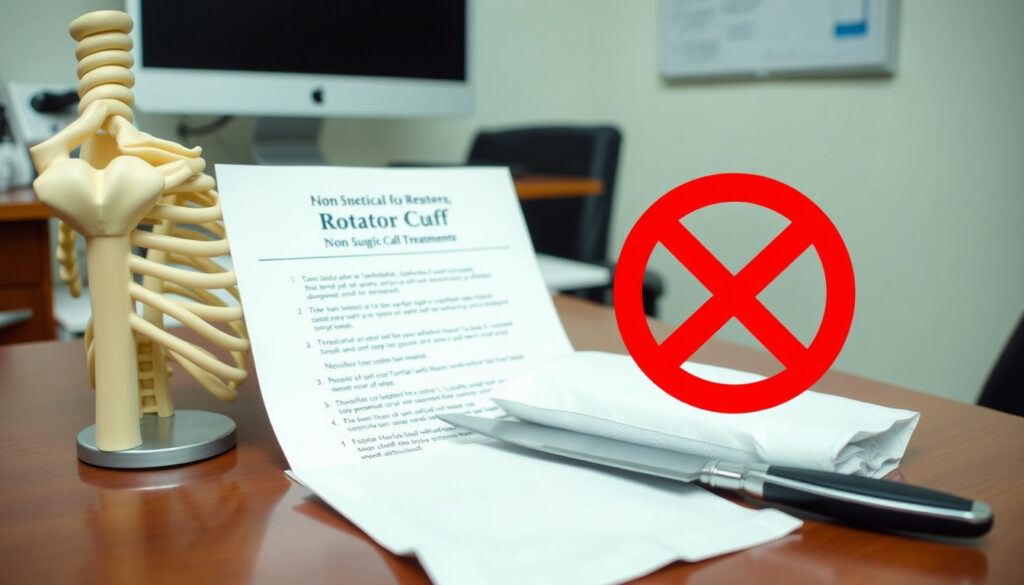
When Not to Have Rotator Cuff Surgery: 5 Key Reasons to Avoid
If you’ve been told you have a rotator cuff tear, your first instinct might be to schedule surgery and get it over with. But for a surprising number of cases, the operating room is not the best place to start.
Rotator cuff tears that do not require surgery: Up to 80% of partial-thickness tears · Recovery time after surgery for daily activities: 4 to 6 months · Rotator cuff repairs that fail or retear: Roughly 10% to 25% depending on age and tear size
Quick snapshot
- Small partial-thickness tears (Cleveland Clinic)
- Asymptomatic tears detected incidentally (Cleveland Clinic)
- Chronic tears with fatty infiltration (Mayo Clinic)
- Patients with high surgical risk or poor healing potential (AAOS)
- No surgical risks or recovery downtime (Cleveland Clinic)
- Often effective for pain management (PMC study)
- Preserves shoulder function for many activities (PMC study)
- Lower cost compared to surgery (OrthoBethesda)
- May not restore full strength for high-demand activities (PMC study)
- Possible progression of tear size (PMC study)
- Pain may persist in some patients (PMC study)
- Limited evidence for long-term tear healing (PMC study)
- Acute large tear in a young active patient (Cleveland Clinic)
- Failure of 6–12 months of conservative care (OrthoBethesda)
- Significant functional impairment or weakness (AAOS)
- High-quality tendon tissue with good muscle condition (Mayo Clinic)
Pros of Nonoperative Treatment
- No surgical risks or recovery downtime
- Often effective for pain management
- Preserves shoulder function for many activities
- Lower cost compared to surgery
Cons of Nonoperative Treatment
- May not restore full strength for high-demand activities
- Possible progression of tear size
- Pain may persist in some patients
- Limited evidence for long-term tear healing
Five key facts, one pattern: nonoperative care works for a wide range of rotator cuff tears, but not all tears are created equal.
| Factor | Value |
|---|---|
| Percentage of partial-thickness tears that heal without surgery | Up to 80% with conservative management (Cleveland Clinic) |
| Success rate of nonoperative treatment for chronic full-thickness tears | Many patients remain pain-free for years (PMC study) |
| Typical recovery time after surgery for daily activities | 4–6 months (Mayo Clinic) |
| Retear rate after surgical repair | 10%–25% depending on age and tear size (OrthoBethesda) |
| Recommended duration of conservative therapy before considering surgery | 6–12 months (AAOS) |
When is it too late to repair a rotator cuff?
Surgical timing for rotator cuff repair is not a simple countdown. Some tears become harder to fix the longer they go untreated, while others remain manageable for years.
What factors determine if a tear is repairable?
- Tear size and retraction: Large tears with tendon retraction (the tendon pulls back from the bone) are technically more difficult to repair. Mayo Clinic notes that tendons that have retracted significantly may not reach the bone attachment site.
- Fatty infiltration: When the muscle belly gets replaced by fat, the tissue quality declines. Repair success drops sharply once fat content exceeds 30-40% of the muscle volume.
- Muscle condition: Atrophied, scarred muscle tissue is less likely to regain strength even after a technically successful repair.
Chronic vs. acute tears and surgical timing
Acute, traumatic tears — say, from lifting something heavy or falling on an outstretched arm — often benefit from early repair within weeks. Chronic, degenerative tears develop slowly over years. Cleveland Clinic orthopaedic surgeons emphasize that chronic full-thickness tears in older patients frequently respond well to nonoperative care, making surgical urgency lower.
For a patient in their 70s with a chronic tear and no pain, delaying surgery indefinitely is often the wiser play — the risks of repair may outweigh any functional gain.
The implication: the “too late” threshold is not a calendar date but a biological one — determined by tissue quality, not time alone.
Is it better to have rotator cuff surgery or not?
This is the central question, and the answer depends heavily on who you are, how active you need to be, and what your shoulder looks like inside.
When nonoperative treatment is effective
- Partial-thickness tears: Up to 80% heal with conservative management, according to Cleveland Clinic.
- Chronic full-thickness tears without severe symptoms: Many patients maintain adequate function for years with exercise rehabilitation and occasional medication (PMC review).
- Patients over 70 with atraumatic tears: Conservative care is often first-line, as the retear rate after surgery rises significantly in this group (Physiopedia).
Pros and cons of surgery vs. conservative management
A single comparison table, one clear trade-off: surgery offers better structural outcomes for large acute tears but carries recovery time and failure risk.
| Factor | Nonoperative Treatment | Surgery |
|---|---|---|
| Tear size best suited for | Partial thickness, small full-thickness (<3 cm) | Large acute tears (>3 cm) |
| Recovery timeline | Weeks to months; no immobilization | 4–6 months for daily activities; up to 12 months for full strength |
| Pain resolution | High for low-demand patients | High in appropriately selected patients |
| Strength restoration | Good for daily tasks; limited for heavy lifting | Potentially full recovery in young active patients |
| Risk of tear progression | Low to moderate | Low (but retear risk 10–25%) |
| Suitability for older adults (>70) | Preferred first-line | Select cases only |
Young active patients with acute large tears gain the most from surgery. Older patients with chronic tears lose very little by trying conservative care first.
What this means: the decision is not “surgery works better” vs. “conservative works better” — it is who each option fits. A 35-year-old construction worker and a 72-year-old retiree face entirely different trade-offs.
How bad does a rotator cuff need to be for surgery?
Surgery is not reserved for every tear. Orthopaedic surgeons use specific thresholds to decide when the risks of operating are outweighed by the expected benefit.
Tear size and symptom severity criteria
- Smaller than 1 cm: Almost always managed nonoperatively initially.
- Between 1 and 3 cm: May be considered for surgery if symptoms persist after 6–12 months of conservative care (OrthoBethesda).
- Larger than 3 cm: Surgery is typically recommended, especially in active patients with good tissue quality (Cleveland Clinic).
- Muscle atrophy (Goutallier grade 3 or 4): Advanced fatty infiltration makes surgical outcomes poor — nonoperative management or reverse arthroplasty may be considered.
Symptom duration and failure of conservative care
Orthopaedic guidelines from the American Academy of Orthopaedic Surgeons recommend exhausting nonoperative options — typically 6 to 12 months of structured physical therapy and activity modification — before considering surgery. Patients who fail to improve during that window become surgical candidates.
The catch: “failure of conservative care” is not the same as “has a rotator cuff tear.” Many people live with asymptomatic tears for years without any functional decline.
What can you never do again after rotator cuff surgery?
Surgery does not always mean “back to normal.” Even successful repairs carry permanent adjustments to how you use your shoulder.
Long-term activity restrictions
After rotator cuff repair, most patients return to daily activities like dressing, driving, and light lifting. But heavy overhead work — construction, painting ceilings, moving furniture — often requires permanent modifications. The repaired tendon is never as strong as the original healthy tissue, and the retear risk is highest in the first year (Mayo Clinic).
Impact on sports and heavy lifting
- Swimming: Freestyle and butterfly strokes place high demands on the repaired rotator cuff. Many swimmers need to switch to modified strokes or shorter distances.
- Weightlifting: Overhead press and heavy bench press may be limited permanently. Some patients cannot return to pre-injury lifting numbers (PMC study).
- Racquet sports: Tennis and pickleball involve repetitive overhead motion. Some patients return fully, others experience shoulder fatigue or pain with high-volume play.
A high school baseball pitcher who has a rotator cuff repair has a reasonable chance of returning to pitching, but at reduced velocity and with a permanently altered throwing motion.
The pattern: surgery offers structural repair but trades it for permanent activity constraints. For someone whose primary sport or livelihood involves overhead power, the decision is a real trade-off, not a simple fix.
Are you ever the same after rotator cuff surgery?
Recovery milestones are well-documented, but “the same” is a high bar. Most patients report improvement, but full symmetry — equal strength, same range of motion, no fear of re-injury — is not guaranteed.
Recovery milestones and outcomes
- 0–6 weeks: Immobilization in a sling; no active shoulder motion; passive range of motion only.
- 6–12 weeks: Begin active-assisted exercises under guidance of a physical therapist.
- 3–6 months: Return to light daily activities; start strengthening.
- 6–12 months: Gradual return to heavier activities and sports; full strength not expected before 9–12 months (Cleveland Clinic).
Factors that influence full return to function
Research published in PMC shows that younger age, smaller tear size, better preoperative muscle quality, and adherence to postoperative rehabilitation all predict better outcomes. Conversely, patients over 65 with large tears and poor tissue quality are less likely to achieve a “normal” shoulder after surgery.
The trade-off: for a 45-year-old recreational athlete with a 2 cm tear who completes 12 months of rehab, “same” might be achievable. For a 68-year-old with a 4 cm tear and fatty infiltration, “same” likely is not — but they may still get meaningful pain relief and improved function.
mediciortho.com, caringmedical.com, orthop.washington.edu, drglennatolbert.com, toaeasttn.com, virtua.org, massgeneral.org
Frequently asked questions
What is the success rate of nonoperative rotator cuff treatment?
Up to 80% of partial-thickness tears respond well to conservative management, including physical therapy, NSAIDs, and activity modification (Cleveland Clinic). Many patients with chronic full-thickness tears also achieve adequate pain relief and function without surgery.
Can a rotator cuff tear get worse if you do not have surgery?
Yes, some tears can progress in size over time. Research in PMC notes that structural deterioration may occur even with nonoperative management. Regular monitoring and symptom tracking are important.
How long does rotator cuff recovery take without surgery?
Most patients see significant improvement within 4–12 weeks of starting physical therapy. Full improvement in strength and function may take 4–6 months for partial tears and up to a year for larger tears managed conservatively (OrthoBethesda).
Are there exercises I should avoid with a rotator cuff tear?
Yes. Avoid overhead presses, heavy bench press, pull-ups, and exercises that cause sharp pain. A physical therapist can design a program that strengthens without aggravating the tear (Cleveland Clinic).
Does age affect the decision to have rotator cuff surgery?
Significantly. Patients over 70 with chronic tears are strong candidates for nonoperative care, as the retear rate after surgery increases with age (Physiopedia). Younger active patients with acute tears are more likely to benefit from surgical repair.
What happens if a rotator cuff tear is not repaired?
Some tears remain stable and asymptomatic for years. Others may enlarge, leading to muscle atrophy, fatty infiltration, and worsening weakness. Pain may increase over time in some patients (PMC review).
Is physical therapy enough for a full-thickness rotator cuff tear?
For many chronic full-thickness tears, yes. Exercise rehabilitation can reduce pain and improve function even without the tendon healing anatomically. Success rates depend on tear size, activity demands, and adherence to therapy (PMC).
What pain medication is used for rotator cuff tear without surgery?
NSAIDs such as ibuprofen and naproxen are commonly used. Corticosteroid injections can also provide temporary relief by reducing inflammation. Repeated injections should be avoided because they may weaken the tendon (Cleveland Clinic).
For anyone facing a rotator cuff tear diagnosis, the question is not simply “should I have surgery?” but “who is the best candidate for each path?” The choice — surgery or conservative care — is clear only after weighing tear size, age, activity demands, and realistic expectations. For many, the best treatment never involves an operating room at all.
More related posts
 Flower Names for Girls: Unique, Vintage & International
 The Killing of a Sacred Deer: Ending, Plot & Meaning Explained
 Mar-a-Lago Face: What It Is, How to Get It & Costs
 Crisis on Infinite Earths Watch Order: Episode Guide
 What Is a Content Delivery Network? Definition, Benefits & Usage
 St. Michael the Archangel – Prayer, Patron Saint, Schools
 Harry Potter and the Sorcerer’s Stone Cast: Complete List
 Nicki Minaj Net Worth: $150 Million Richest Female Rapper
