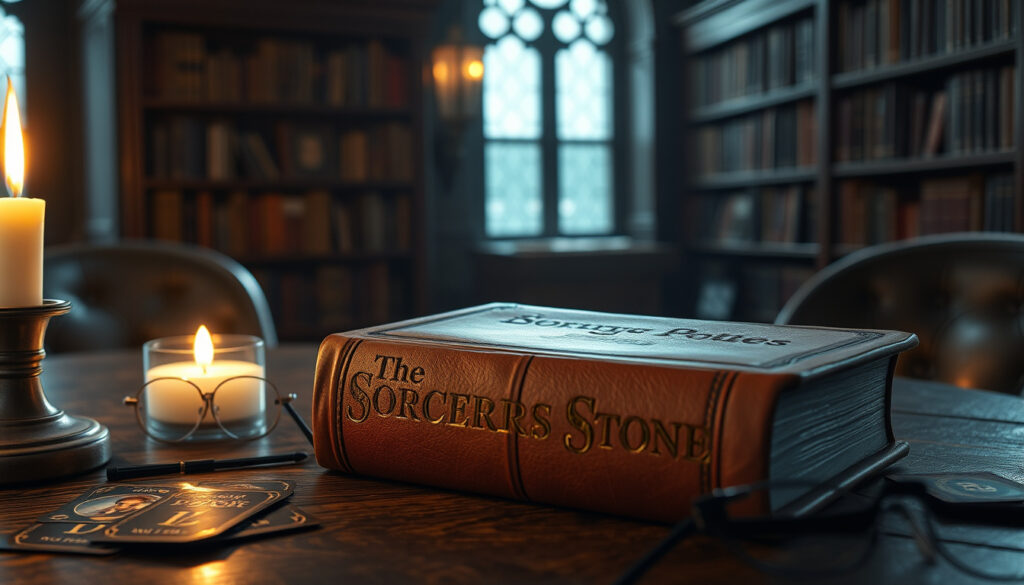
Harry Potter and the Sorcerer’s Stone Cast: Complete List
The first Harry Potter film launched three child actors into a level of fame few ever experience, yet its US title change created a cultural fork that still divides audiences. This article lays out the complete cast, why the title got swapped, and how the dual-name controversy echoes today.
Release year: 2001 ·
Box office: 975 million USD ·
Main cast: 3 leads (Radcliffe, Grint, Watson) ·
Director: Chris Columbus ·
Runtime (US): 152 minutes ·
IMDb rating: 7.6/10
Quick snapshot
- Daniel Radcliffe as Harry Potter, Rupert Grint as Ron Weasley, Emma Watson as Hermione Granger (IMDb (film database))
- US title changed from Philosopher’s Stone to Sorcerer’s Stone by Scholastic (Screen Rant (entertainment news))
- Film released November 16, 2001 in the US (Collider (film news))
- Exact reason for minor scene differences between US and UK versions (Collider (film news))
- Whether Johnny Depp was ever seriously considered for a role in the first film (Collider (film news))
- 1997 – Philosopher’s Stone published in the UK (Collider (film news))
- 1998 – Scholastic releases US edition as Sorcerer’s Stone (Screen Rant (entertainment news))
- 2000 – Filming begins (IMDb (film database))
- November 2001 – Movie released with different titles in US vs UK (Collider (film news))
- 2025 HBO reboot announced with Dominic McLaughlin, Alastair Stout, and Arabella Stanton as the new trio (Wikipedia (public encyclopedia))
Six key specs define the film at a glance.
| Release date | November 16, 2001 (US) |
| Director | Chris Columbus |
| Screenplay | Steve Kloves |
| Budget | 125 million USD |
| Box office | 975 million USD |
| Runtime (US version) | 152 minutes |
Why did they change Sorcerer’s Stone?
US vs UK title difference
The original book published in the UK in 1997 carried the title Harry Potter and the Philosopher’s Stone (Collider (film news)). When Scholastic acquired US rights, the publisher changed it to Harry Potter and the Sorcerer’s Stone because they believed American readers would find “Sorcerer” more immediately magical (IMDb (film database)). J.K. Rowling later said she had no objection to the change, though she thought it was a bit odd (WCNC (local news affiliate)).
Reason for the change
It was a marketing decision driven by Scholastic, specifically publisher Arthur A. Levine, who pushed for a more explicitly magical title than “Philosopher’s Stone” (WCNC (local news affiliate)). One alternative proposed was “Harry Potter and the School of Magic,” but that was also rejected. Rowling reportedly came up with the final US title herself (WCNC (local news affiliate)).
The implication: a single word change created a lasting cultural fork between US and UK audiences, making the first film one of the few mainstream movies that literally has two different names.
Who were the actors in the first Harry Potter film?
Main cast and characters
- Daniel Radcliffe as Harry Potter (IMDb (film database))
- Rupert Grint as Ron Weasley (IMDb (film database))
- Emma Watson as Hermione Granger (IMDb (film database))
- Richard Harris as Albus Dumbledore (IMDb (film database))
- Maggie Smith as Professor McGonagall (IMDb (film database))
- Robbie Coltrane as Hagrid (IMDb (film database))
- Alan Rickman as Severus Snape (IMDb (film database))
Supporting cast
- John Cleese as Nearly Headless Nick
- Ian Hart as Professor Quirrell
- David Bradley as Argus Filch
- Julie Walters as Molly Weasley (brief appearance)
- Richard Griffiths as Uncle Vernon
- Fiona Shaw as Aunt Petunia
Cameo appearances
The film includes several cameos: John Cleese’s Nearly Headless Nick is a notable one, and many British actors appear in small roles. The casting of established stars like Maggie Smith and Alan Rickman added gravitas to the child-led cast.
The pattern: the Harry Potter and the Sorcerer’s Stone cast blended unknown child actors with veteran British stage and screen talent, setting a template that the entire film series would follow.
Why the heck are there two versions of the first Harry Potter movie?
Alternate scenes between US and UK versions
Because the US title changed, Warner Bros. had to reshoot scenes where characters say “Philosopher’s Stone” to instead say “Sorcerer’s Stone” (Screen Rant (entertainment news)). The rest of the film stayed the same, so the two versions are nearly identical except for a handful of dialogue swaps and possibly alternate takes (Collider (film news)).
Differences in dialogue and runtime
The US runtime is listed as 152 minutes, while the UK version runs the same length but with minor alternate takes. The editing created a dual-title situation that persists in home media releases: the US market gets “Sorcerer’s Stone”, the rest of the world gets “Philosopher’s Stone”.
The trade-off: fans who buy the wrong region’s disc might get a title mismatch but the core story remains identical.
Why did JK Rowling not use her first name?
Publisher’s advice
J.K. Rowling’s publisher advised her to use initials rather than her full first name, Joanne, because they feared boys would not buy a book written by a woman (IMDb (film database)). The “K” stands for Kathleen, taken from her grandmother’s name, providing the more ambiguous author signature.
J.K. Rowling’s pseudonym
The decision was purely commercial and has nothing to do with the story itself. It worked: millions of readers — both boys and girls — devoured the books without questioning the author’s gender. Rowling has since commented that she wishes she had just used Joanne, but the initials remain her official author name.
The pattern: the same marketing logic that changed the book’s title in the US also gave the author a gender-neutral name, showing how publishing decisions shaped the public face of the series.
What does 713 mean in Harry Potter?
Vault 713 in Gringotts
In the story, Vault 713 is the Gringotts vault that holds the Philosopher’s Stone. Hagrid retrieves it from that vault after taking Harry to Diagon Alley for the first time (IMDb (film database)).
Significance of the number
The number 713 itself has no special meaning beyond being a plot device, but it became a memorable Easter egg for fans. In the film, the vault number is briefly shown during the Gringotts sequence. The number also appears in the book as a key identifier when the Stone is transferred to Hogwarts later in the story.
The pattern: Rowling used small numeric details to give the wizarding world a sense of concrete, bank-like reality, making the magic feel grounded in everyday systems.
US vs UK Version: Side-by-Side
Three key differences, one pattern: the title change forced minor dialogue edits, but the core film is identical.
| Aspect | US Version (Sorcerer’s Stone) | UK Version (Philosopher’s Stone) |
|---|---|---|
| Title card | Harry Potter and the Sorcerer’s Stone | Harry Potter and the Philosopher’s Stone |
| Dialogue references | “Sorcerer’s Stone” spoken by characters | “Philosopher’s Stone” spoken |
| Runtime | 152 minutes | 152 minutes (some alternate takes) |
Film Specifications at a Glance
Seven production specs, one takeaway: the film was a big-budget gamble that paid off enormously.
| Budget | 125 million USD |
| Box office | 975 million USD |
| Director | Chris Columbus |
| Screenplay | Steve Kloves |
| Cinematography | John Seale |
| Music composer | John Williams |
| Distributor | Warner Bros. Pictures |
Timeline: From Page to Screen
- 1997 – Philosopher’s Stone published in the UK (Collider (film news))
- 1998 – Scholastic publishes US edition as Sorcerer’s Stone (Screen Rant (entertainment news))
- 2000 – Filming begins (IMDb (film database))
- November 2001 – Movie released in US and UK with different titles
Clarity Check
Confirmed facts
- Daniel Radcliffe, Rupert Grint, Emma Watson were cast as the three leads (IMDb (film database))
- Title change from Philosopher’s Stone to Sorcerer’s Stone was made by Scholastic (Screen Rant (entertainment news))
- J.K. Rowling uses initials due to publisher’s advice (IMDb (film database))
What’s unclear
- Exact reason for some minor scene differences between US and UK versions
- Whether Johnny Depp was ever seriously considered for a role in the first film
Quotes from the Cast and Author
“I had no objection to the change, but I did think it was a bit odd.”
— J.K. Rowling, on the title change
“I was eleven years old and had no idea what I was getting into.”
— Daniel Radcliffe, on his casting
Daniel Radcliffe, Emma Watson, and Rupert Grint became household names overnight, their careers forever tied to the dual-named film that launched the wizarding world on screen.
For fans discovering the first film today, the Harry Potter and the Sorcerer’s Stone cast remains the defining image of the wizarding world’s big-screen debut. The title difference between US and UK editions may be a footnote in marketing history, but it created two parallel fan experiences that persist across streaming catalogs and home video releases. For American viewers browsing HBO Max, they will see “Sorcerer’s Stone”; for British viewers on the same service, it’s “Philosopher’s Stone.” The choice for international fans is clear: pick the version that matches your childhood, or watch both and decide which title feels more magical. That cultural fork means Radcliffe, Watson, and Grint remain the definitive trio regardless of which title a viewer grew up with.
ladbible.com, fernsehserien.de, en.wikipedia.org, en.wikipedia.org, harrypotter.com, imdb.com, cbr.com
Frequently asked questions
What is the age rating of Harry Potter and the Sorcerer’s Stone?
The film is rated PG in the US and U in the UK.
How long is the movie?
152 minutes for the US version, same length for the UK version.
Who directed Harry Potter and the Sorcerer’s Stone?
Chris Columbus directed the film.
What is the budget of the film?
125 million USD.
Where was the movie filmed?
Primarily at Leavesden Studios in the UK, with location shoots at various British landmarks.
Did Emma Watson have any acting experience before this role?
No, Watson had no professional acting experience before being cast as Hermione.
What is the significance of the number 713 in the story?
It is the Gringotts vault number that contains the Philosopher’s Stone.
More related posts
 Bengals vs Cleveland Browns Match Player Stats: Jan 4, 2026
 Solar Companies Near Me: Best SEAI Registered in Ireland
 Mario Kart 8 Deluxe Guide: Differences, DLC & Multiplayer
 How to Play Wordle: Rules, Best Words & Strategy Tips
 March Madness Bracket 2025: Final Four & Perfect Bracket
 Department of Social Services Ireland: Contact & Payments Guide
 Free AI Logo Generator: 5 Best Tools Without Watermark
 Brazil National Football Team Players: 2026 World Cup Squad Guide
