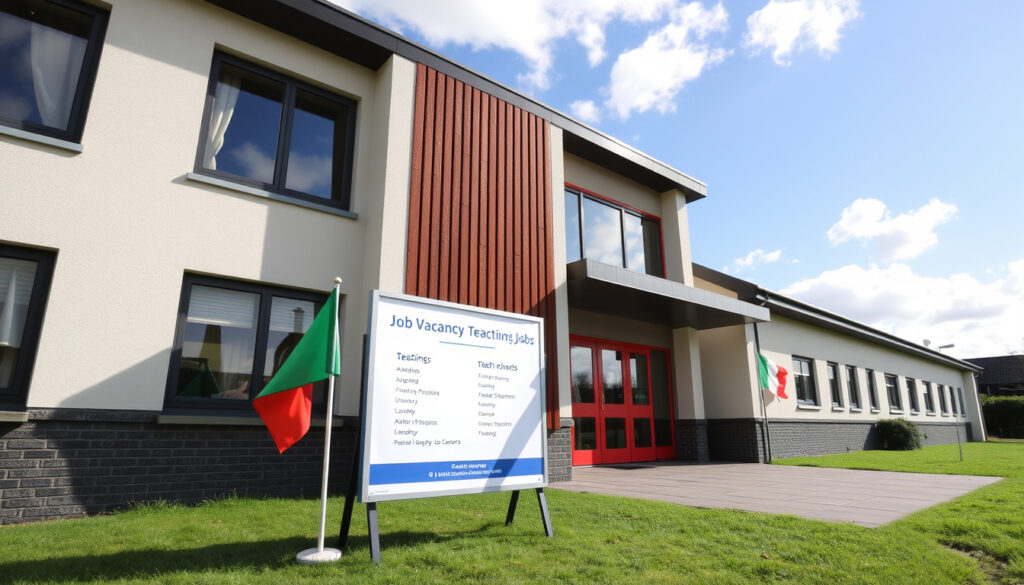
Teaching Jobs Near Me: Demand, Salary, and How to Find in Ireland
If you’ve been searching for teaching jobs near you in Ireland, you’re not alone — and you’re in luck. The demand for qualified teachers, especially in STEM and special education, is strong, with over 1,760 active ads on EducationPosts.ie at any given time. This guide cuts through the noise to give you the real picture on salary, substitute rules, and where to find the best openings.
Active teaching job ads in Ireland: 1,760+ (EducationPosts.ie) ·
Average teacher salary (starting): €37,000 per year ·
Highest demand subjects: STEM, Special Education, Irish ·
Substitute teacher hourly rate: €20–€40 ·
Teacher career switchers top 3: Instructional Design, Corporate Training, EdTech
Quick snapshot
- High demand for STEM and Special Education teachers (ASTI (Irish post-primary teachers’ union))
- Starting salary around €37,000, rising to €70,000+ (INTO (Irish primary teachers’ union))
- Substitute teachers can work 5 consecutive days before contract requirements change (TUI (Teachers’ Union of Ireland))
- Exact number of unfilled teaching positions nationwide (Taylor & Francis (academic research))
- Average time to find a teaching job after applying (Taylor & Francis (academic research))
- Career switch top destination: Instructional Design (Indeed (job search platform))
- Department may expand substitution opportunities for career-break teachers (INTO)
- Abatement waiver for retired teachers extended (INTO)
Ten data points that define the teaching job landscape in Ireland, drawn from union reports, job boards, and government circulars.
| Fact | Value | Source |
|---|---|---|
| Active teaching jobs (Ireland) | 1,760+ | EducationPosts.ie |
| Average starting salary | €37,000 | INTO (Irish primary teachers’ union) |
| Top demand subject | STEM and Special Education | ASTI (Irish post-primary teachers’ union) |
| Substitute daily rate (qualified) | €223.34 | ClassCover (substitute teacher platform) |
| Substitute daily rate (unqualified) | €162.07 | ClassCover |
| Holiday pay accrual | 11% of daily rate | ClassCover |
| Post-primary salary scale (Feb 2026) | €46,948 – €85,411 | Superprof Ireland (tutoring platform) |
| Schools with no substitute available | 90% | ASTI |
| Schools using non-qualified teachers | 73% | ASTI |
| National average teacher salary (Indeed) | €40,739 | Indeed (job search platform) |
Is there a demand for teachers in Ireland?
Short answer: yes. A 2025 survey by ASTI found that 90% of schools reported no substitute teachers available to cover absent staff, and 73% said they had to hire non-qualified or casual teachers to manage supply gaps. Academics have described the situation as a crisis in teacher supply.
For anyone looking for teaching jobs near them, the shortage means openings are abundant — but competition for permanent posts in desirable locations remains fierce. The real bottleneck: qualified applicants.
What type of teacher is in highest demand?
- STEM subjects (Science, Technology, Engineering, Maths) — consistently flagged as shortage areas by the Teaching Council (regulatory body)
- Special Education / SEN — growing demand as inclusion policies expand
- Irish language — medium schools and Gaeltacht areas report persistent vacancies
- Special Needs Assistants (SNAs) — also in high demand across primary and secondary levels, per EducationPosts.ie
The implication: if you hold qualifications in any of these areas, you’re in a strong bargaining position. For general primary teachers, the market is tighter though still active.
How much does a teacher get paid in Ireland?
Pay scales are published annually by the Department of Education and negotiated with unions. From March 2025, a 2% increase or €1,000 (whichever is greater) was applied to whole-time basic scale salaries, according to INTO circular. A typical starting teacher earns around €37,000, rising to €70,000+ with experience. The post-primary scale is projected to reach €46,948 to €85,411 from February 2026, as reported by Superprof Ireland.
While starting salaries are competitive, the real financial gain comes with seniority. A teacher reaching the top of the scale earns more than double the starting point — a ladder that takes roughly 15–20 years to climb.
What is the hourly rate for a teacher in Ireland?
- Qualified substitute: €223.34 per day (approx €28–€37 per hour) under DES Circular 0050/2025, per ClassCover
- Unqualified substitute: €162.07 per day (approx €20–€27 per hour) — same source
- Non-casual part-time teachers: paid pro-rata on the salary scale plus allowances, with holiday pay at 12% of time worked (ASTI guidance on non-permanent teachers)
- Holiday pay for substitutes: accrues at 11% of daily rate per ClassCover
The trade-off: substitute work offers flexibility and decent hourly pay, but lacks job security and benefits of permanent employment. Many teachers combine subbing with part-time contracts to build experience.
What is the 5 day rule for subbing?
In Ireland, a substitute teacher can work up to 5 consecutive days in the same class or school without triggering a long-term contract requirement. After day 5, the school must offer a fixed-term contract. This rule, confirmed by TUI, protects both the teacher’s rights and the school’s operational flexibility.
What is the 10 minute rule in teaching?
- The 10-minute rule is a classroom management technique: use the first 10 minutes of a lesson for settling, instructions, and warm-up activities. It’s widely taught in initial teacher education programmes in Ireland.
While not a formal regulation, experienced teachers swear by it. Getting the opening right reduces disruption later.
What is the 80/20 rule in teaching?
- 80/20 rule (Pareto principle applied to behaviour): approximately 80% of classroom disruptions come from 20% of students. Identifying that 20% early allows targeted support.
The catch: no rule replaces the need for strong relationships and consistent routines. These strategies are tools, not magic.
What is the hardest age to teach?
Opinions differ, but many Irish educators consider the transition to secondary school (ages 12–14) the hardest age to teach due to social and academic adjustment challenges.
What career do most teachers switch to?
Teachers leaving the classroom most commonly move into instructional design, corporate training, educational consulting, and EdTech roles. Others transition to publishing, e-learning development, or non-profit coordination. According to career advisors at the Teaching Council, the skills teachers possess — curriculum design, assessment, communication, project management — are highly transferable.
What are the top career changes for teachers?
- Instructional Designer — creates learning materials for corporate or higher education settings
- Corporate Trainer — delivers professional development programmes
- EdTech Specialist — works with educational technology companies on product design or implementation
- Educational Consultant — advises schools or government bodies on curriculum and policy
- E-Learning Developer — builds online courses and digital learning resources
Why this matters: switching careers doesn’t mean leaving education — it means applying your teaching expertise in a different context. Many teachers find greater flexibility and higher earning potential outside the classroom.
How to find teaching jobs near me?
In Ireland, the go-to platforms are specialised education job boards. EducationPosts.ie lists the most vacancies, followed by Staffroom.ie, and general boards like Indeed.ie and IrishJobs.ie. The Department of Education also publishes vacancies directly.
Applications for popular schools in Dublin and Cork can attract hundreds of candidates. Cast a wider net: consider regional schools, rural placements, and substitute work as an entry point.
Where to look for teaching jobs in Ireland?
- EducationPosts.ie — dedicated to teaching and SNA roles across primary, secondary, and special schools
- Staffroom.ie — specifically for teachers, with filters by county and subject
- Indeed.ie — use filters like “teacher”, “SNA”, “substitute” and set your location
- IrishJobs.ie — broader but includes education listings
- Department of Education vacancy list — published on education.ie for permanent posts
What are the best websites for teaching jobs in Ireland?
- EducationPosts.ie — market leader with 1,760+ active ads
- Staffroom.ie — growing platform with school reviews
- ClassCover.ie — app-based for substitute jobs
- INTO and ASTI job boards — union members get early access
The pattern: most jobs are posted between March and June for September starts. Subbing opportunities spike in October and February when absences peak.
Steps to Find Teaching Jobs Near Me in Ireland
- Check your registration — ensure you’re registered with the Teaching Council. Non-Irish qualifications may need recognition.
- Create profiles on job boards — upload CV and set job alerts on EducationPosts.ie, Staffroom.ie, and ClassCover.ie for subbing.
- Network locally — contact school principals directly, join teacher union branches (ASTI, INTO, TUI) for insider info.
- Target high-demand subjects — if you can upskill (e.g., SEN, STEM, Irish), do so. Short courses from universities and the Teaching Council can boost your chances.
- Apply early and follow up — most schools recruit in spring. Persistence pays: send a brief email a week after applying.
- Consider substitute work — it builds classroom experience and school connections. Use the 5-day rule to transition into longer contracts.
Clarity: What we know and what we don’t
Confirmed facts
- High demand for STEM and Special Education teachers in Ireland (ASTI)
- Salary scales published annually by the Department of Education (INTO)
- Substitute teachers can work 5 consecutive days before contract requirements change
- Career-break substitute restrictions suspended for 2024/25
- 90% of schools report no substitute teachers available
What’s unclear
- Exact number of unfilled teaching positions nationwide (Taylor & Francis)
- Average time to find a teaching job after applying
- Precise impact of abatement waiver expansion on retired teacher re-entry
What this means: while the shortage is documented, precise numbers remain elusive, requiring job seekers to rely on local intelligence.
Voices from the profession
“The situation is acute. 90% of principals told us they couldn’t get a substitute when they needed one. That’s not a blip — it’s a structural problem.”
— Spokesperson for ASTI
“We’ve seen the Department take positive steps — expanding substitution opportunities for career-break teachers and extending the abatement waiver for retirees. But the pipeline of new entrants still isn’t keeping pace with demand.”
— Representative from INTO
“Teachers possess a skill set that translates beautifully into corporate environments. Instructional design, project management, communication — these are gold in the private sector.”
— Careers advisor at the Teaching Council
For any teacher considering a move, the message is clear: your skills are valuable both inside and outside the classroom. The shortage in schools means you have options — but the best option depends on your priorities.
Understanding the local demand for educators is easier when you review local teaching job openings alongside the national salary scales.
Frequently asked questions
What qualifications do I need to teach in Ireland?
You need registration with the Teaching Council. For primary: a recognised Bachelor of Education (B.Ed.) or postgraduate qualification. For post-primary: a degree in the subject plus a Postgraduate Diploma in Education (PGDE).
How long does it take to become a qualified teacher in Ireland?
A B.Ed. takes four years. A PGDE after a degree takes two years full-time or three years part-time. Accelerated routes exist for career-changers with relevant experience.
Can I teach in Ireland with a foreign teaching degree?
Yes, but your qualifications must be assessed and recognised by the Teaching Council. The process can take several months.
What is the probation period for new teachers in Ireland?
Newly qualified teachers (NQTs) undergo a probation period called Droichead, lasting typically one to two years, with mentoring and classroom observation.
Are there teaching jobs for non-Irish speakers in Ireland?
Yes, especially in international schools and English language academies. However, Irish-medium schools require fluency. English-medium schools accept non-Irish speakers for most subjects.
What is the difference between a teacher and an SNA in Ireland?
A teacher delivers curriculum; a Special Needs Assistant (SNA) provides care support to students with additional needs. Both roles are in demand, but qualifications differ.
How do I apply for teaching jobs through the Department of Education?
The Department posts permanent vacancies on education.ie. For temporary and substitute roles, use EducationPosts.ie or the Appointed Persons Scheme for substitutes.
For teachers in Ireland, the choice is clear: lean into high-demand subjects, leverage substitute work as a stepping stone, and build your network through unions and local education centres. The shortage isn’t going away — but with a strategic approach, you can turn it into opportunity.
More related posts
 Oscar De La Hoya: Net Worth, Face Injury & Boxing Legacy
 Marriott Bonvoy Credit Card: Is It Worth the Annual Fee
 Mariners vs Orioles Player Stats: Naylor Grand Slam Decides
 Green Noise for Sleep – Softer Nature Sounds for Rest
 McDonald’s Near Me: Find Locations, Hours, Menu & Prices
 What Is a Vector Database? Definition and Uses
 Precio del Dólar en Mexico Today: USD/MXN Rate Comparison
 Atmosphere Taylor Jenkins Reid: Plot, Queer Themes & Age
